Land & New Construction | North Texas
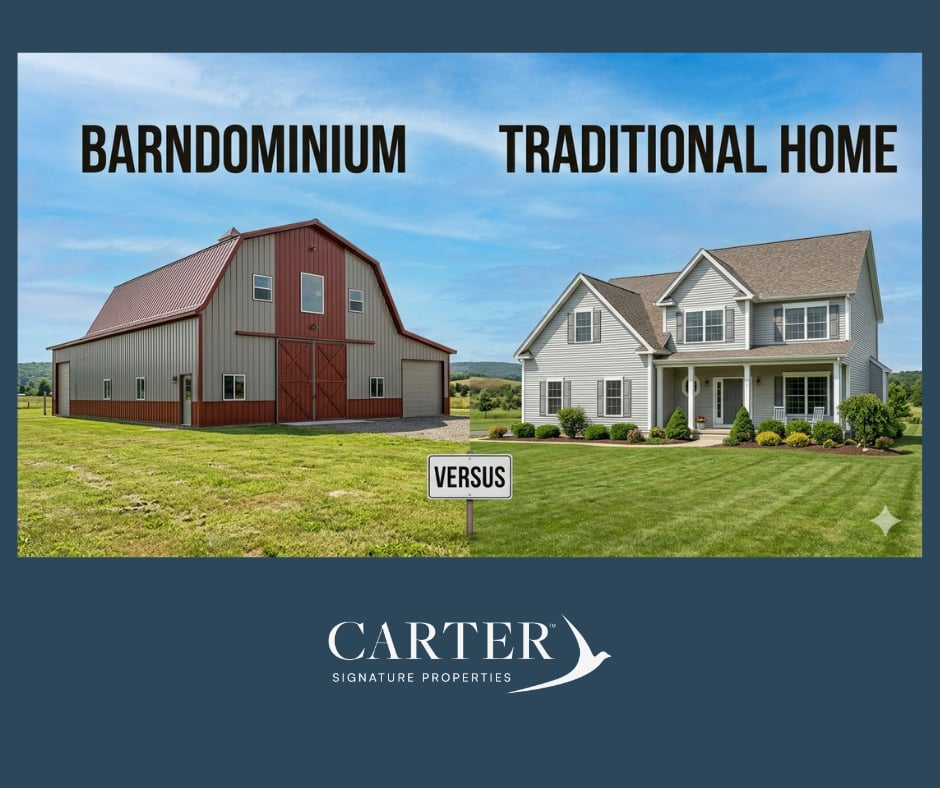
Buying Land in North Texas: Should You Build a Traditional Home or a Barndominium?
Is a barndominium cheaper than a traditional home on land in North Texas?
Yes — most of the time. A barndo in Wise, Cooke, or Montague County typically runs $125–$175 per square foot to build, compared to $200–$300 per square foot for a traditional stick-built home. But cheaper up front doesn't always mean smarter long term.
So You Want to Buy Land in North Texas
Good call. Rural land north and northwest of Fort Worth — out through Wise County, Cooke County, Montague County, and the edges of Denton and Tarrant — has quietly become one of the smartest plays in Texas real estate. City folks want out. Families want acreage. Remote work made it possible. And the drive to Alliance, Downtown Fort Worth, or DFW Airport is still reasonable.
Once you lock down the land, the next question is always the same: do we build a regular house, or do we go the barndominium route?
Both are solid. Neither is automatically right. Let's walk through it like adults — no sugar-coating, no Pinterest fantasy.
What Is a Barndominium, Exactly?
A barndominium (or "barndo") is a home built inside a metal post-frame or steel-framed shell — the same kind of structure used for big workshops, equipment barns, and hangars. The outside looks agricultural. The inside can look like anything from a polished modern farmhouse to a full luxury spread with vaulted ceilings, quartz counters, and a show-stopping kitchen.
You can also build a "shouse" (shop-house) — part living space, part workshop or garage — under one big roof. Popular with folks who have trucks, trailers, tractors, boats, or a side hustle that needs square footage.
Traditional Home vs. Barndominium: The Honest Comparison
| Factor | Traditional Home | Barndominium |
|---|---|---|
| Cost per sq ft (2026) | $200–$300+ | $125–$175 (shell + finish out) |
| Build time | 8–14 months | 4–8 months |
| Financing | Standard construction loans, conventional, VA, FHA | Harder — fewer lenders, often needs a specialty or portfolio loan |
| Insurance | Standard homeowners | Can be tricky; some carriers classify it differently |
| Appraisals & resale | Plenty of comps, easy to value | Fewer comps, especially in neighborhoods without other barndos |
| Customization | High, but limited by framing | Very high — big open spans, no interior load walls |
| Energy efficiency | Excellent with modern builds | Excellent if properly insulated — cheap spray foam is the make-or-break |
| Longevity | 50–100 years with upkeep | 40–60+ years — metal holds up great if moisture is controlled |
Why People Pick the Barndominium Route
1. Speed and Cost
You can get a 2,500-square-foot barndo livable in under six months for roughly the price of a 1,500-square-foot traditional build. On rural land in Wise County or Montague County, that math is hard to argue with.
2. Big Open Spaces
Metal framing means wide clear spans. No load-bearing walls in the middle of the house. You can have a 40-foot great room, an RV bay attached to the kitchen, or a workshop that opens straight into the living area. Try that with traditional framing and you're adding $40K in steel beams.
3. Low Exterior Maintenance
A metal shell doesn't rot, doesn't need paint every five years, and shrugs off North Texas hail better than shingles and siding. In Wise and Montague counties — where storms can get angry — that matters.
4. Lifestyle Fit
If you've got horses, cattle, a classic car collection, a welding shop, or a trailered boat, a barndo lets you keep everything under one roof. That's the whole appeal of rural land in the first place.
Why a Traditional Home Might Still Be the Better Call
1. Financing Is Easier
This is the #1 thing people underestimate. Most big lenders are comfortable with traditional construction. Barndos? Many banks either won't touch them or require 25–35% down with specialty terms. If you're financing the build, call your lender before you fall in love with a steel-frame floor plan.
2. Appraisal and Resale
Appraisers compare your home to recent sales. In rural parts of North Texas, barndo comps are getting better — but in some neighborhoods, there still aren't enough to support the value you think you built. A traditional home in a traditional subdivision almost always appraises cleanly.
3. Deed Restrictions and HOAs
Some acreage subdivisions in Denton County, Wise County, and Parker County have deed restrictions that quietly ban metal exteriors, limit outbuilding size, or require minimum masonry percentages. Always — and I mean always — read the restrictions before you close on the dirt. This is where I see buyers get heartbroken.
4. Long-Term Property Values
Traditional homes have a deeper, longer track record. According to the Texas Real Estate Research Center at Texas A&M, rural Texas home values have appreciated steadily for decades. Barndos are newer to the resale market, and the data is still catching up.
What to Check Before You Buy the Land
This is the part most buyers skip. Don't be most buyers.
- Deed restrictions and HOA rules. Get them in writing. Read every page.
- Zoning and permitted use. Some counties allow a barndo as a primary residence; others only allow it as an accessory structure.
- Utilities. Is there a water well or co-op water? Septic or sewer? Electric service? Running utilities to a remote lot can add $20K–$80K fast.
- Road access and easements. Recorded access, maintained road, and any shared-road agreements.
- Floodplain and soil. Pull the FEMA map. Get a soil test before you decide where to set the foundation.
- Ag exemption status. Huge for property taxes. Losing an active ag exemption can raise your tax bill dramatically.
- Mineral rights. North Texas has oil, gas, and gravel activity. Know what's conveying and what isn't.
Financing a Barndo: What Actually Works
Most buyers use one of three paths:
- Cash or land-equity loan — simplest, if you have the capital.
- Local or community bank construction loan — many Texas community banks in Decatur, Bowie, Bridgeport, Gainesville, and Muenster will finance barndos because they understand the market. The big national lenders often won't.
- USDA Rural Development loans — in qualifying rural areas, this can be a powerful option for primary residences. Details on the USDA Rural Development site.
VA and FHA loans can work on barndos, but the home has to meet specific property standards — not every builder can deliver that. Ask your lender before you design.
Resale: The Part Nobody Wants to Talk About
Here's the truth. A well-built barndo on good acreage in Wise, Cooke, or Montague County will sell. The buyer pool is smaller than for a traditional home, but it's loyal, it's growing, and it's cash-heavy. Buyers who want a barndo really want a barndo.
Where barndos struggle on resale is when they're built on small lots, in restrictive subdivisions, or finished out cheaply. A 1,800-square-foot barndo with laminate counters and a gravel driveway on one acre is harder to sell than a 1,800-square-foot traditional brick home on the same lot.
If you plan to live there 20 years, resale matters less. If you plan to move in five, build to the higher end of the market you're in.
Which One Should You Build?
A barndominium is likely the better fit if:
- You have rural acreage with no restrictive HOA
- You want a workshop, shop, or barn attached to your living space
- You want to build faster and cheaper per square foot
- You're paying cash or have financing lined up with a barndo-friendly lender
- You plan to stay long-term or live rural indefinitely
A traditional home is likely the better fit if:
- You're building in a deed-restricted subdivision or an established neighborhood
- You need conventional financing through a major lender
- Resale in 5–10 years is part of the plan
- You want the widest possible buyer pool when you sell
- The lot or community won't support a barndo aesthetic
Frequently Asked Questions
Can I get a regular mortgage on a barndominium in Texas?
Sometimes, but not always. Many national lenders won't finance barndos. Local Texas community banks, USDA Rural Development loans, and some portfolio lenders will. Talk to your lender before you design — it's the single biggest factor in whether your plan is realistic.
How much does it cost to build a barndominium in Wise County or Montague County?
As of 2026, expect roughly $125–$175 per finished square foot for a quality barndo in North Texas, not counting land, site prep, well, septic, or utility hookups. Higher-end finishes push that number up fast. Traditional construction in the same counties typically runs $200–$300 per square foot.
Will a barndominium hurt my property value compared to a traditional home?
Not automatically. On rural acreage in Wise, Cooke, and Montague Counties, well-built barndos are appreciating alongside traditional homes. Where they struggle is in restrictive subdivisions, on small lots, or when finish quality is low. Location, build quality, and the surrounding comps matter more than the category.
Do I need a real estate agent to buy land in North Texas?
You don't technically need one — but you probably want one. Raw land transactions involve deed restrictions, easements, mineral rights, flood zones, ag exemptions, and utility research that a standard home purchase doesn't. Carter Signature Properties specializes in North Texas land through our North Texas Land Network, and we represent buyers at no cost to them (the seller pays the commission in most transactions).
The Bottom Line
Barndominiums and traditional homes are both great answers — to different questions. The real decision isn't "which one is better." It's "which one fits my land, my financing, my lifestyle, and my exit plan."
Before you sign on any dirt in Wise, Cooke, Montague, Denton, or Tarrant County, walk the property with someone who knows the North Texas land market, understands deed restrictions, and can help you avoid the four or five expensive mistakes that land buyers make every week out here.
Thinking about buying land in North Texas?
Cathy Carter is the #1 REALTOR® in Haslet, the Alliance Area, and North Fort Worth, and she leads the North Texas Land Network — serving landowners and land buyers across Wise, Cooke, Montague, Denton, and Tarrant Counties.
Call or text 972-358-6420 or email [email protected].
Experience the Signature Difference.