Alliance Area Market Insight
Texas Data Centers: The Good, the Bad, and What They Mean for Your Home Value
Do data centers help or hurt home values in North Fort Worth and the Alliance Area? So far, the research says data centers have little measurable effect on nearby home prices in most markets — but the studies are new, they disagree with each other, and the answer for your specific address depends on distance, noise, and what the city approves next.
If you own a home in Haslet, Northlake, Roanoke, Keller, or anywhere along the Alliance corridor in North Fort Worth, you have probably heard the word "data center" more in the last twelve months than in your whole life before that.
You have also probably heard two completely opposite stories. Story one: data centers are a tax-revenue windfall and the reason America stays ahead in AI. Story two: they are power-hungry, water-hungry boxes that will wreck your electric bill and tank your property value.
Here is the honest version. Both stories have real facts behind them, and neither one is the whole picture. Let's walk through what is actually happening, what the data says, and what it means if you are thinking about buying or selling in Tarrant or Denton County.
What's Actually Being Built Around Haslet and North Fort Worth
Texas is one of the biggest data center markets on the planet, with four main hubs — Dallas–Fort Worth, Austin, Houston, and San Antonio. The Alliance corridor has been in this business for a while. Meta's campus off Hillwood's AllianceTexas development was roughly a $1.5 billion project built in phases and finished in 2023.
What changed is the scale. A few examples close to home:
- ACS Group's campus on Hicks Field Road in far north Fort Worth — a 107-acre, five-building project pegged around $2.1 billion, with the first phase running from early 2026 into 2027. The city projects about $57.9 million in new tax revenue over ten years — from a campus expected to bring roughly 37 permanent jobs.
- Westlake announced a data center campus in July 2026 near the Keller and Southlake line, projected to use about 54 million gallons of water a year — roughly what one of Westlake's existing corporate campuses already uses.
- Celestica got approval for a ten-year tax break to build at Alliance Center North.
- And there are more in the pipeline near Eagle Mountain Lake and along the south side of the city.
Statewide, the number that made everyone sit up: in August 2026, Governor Abbott called for an audit of every data center in the grid connection queue, noting the requests totaled roughly 474 gigawatts — more than five times Texas' all-time record electricity demand — and that about 90% of those requests came from data centers.
The Upside: Tax Base, Land Values, and Grid Investment
They pay a lot and ask for very little. A data center puts hundreds of millions of dollars on the city and county tax rolls while using almost no municipal services. No new traffic at rush hour. No demand on parks. That revenue can take pressure off residential tax rates over time — which matters if you own a home here.
Land that had no buyer now has three. This is the part most homeowners miss. Raw acreage near high-voltage transmission lines in Wise, Denton, and north Tarrant County has repriced hard. If you own land along a transmission corridor, your "someday" property may be worth a lot more than the last appraisal district notice suggests.
Construction jobs are real, even if permanent jobs are not. The Meta build employed around 1,200 skilled trade workers at its peak. That is years of paychecks moving through local restaurants, hotels, and rental housing. The permanent headcount afterward was north of 200 — good, but a fraction of the build.
Grid and fiber get upgraded. Substations, transmission, and fiber lines get built to serve these campuses, and the surrounding area inherits that infrastructure.
The Downside: Power, Water, Noise, and the Question of Who Pays
Now the part the glossy renderings skip.
Electricity. ERCOT's preliminary long-term forecast projected peak demand could hit roughly 367,790 megawatts by 2032 — more than four times the all-time record of 85,508 MW set in August 2023. Regulators sent that forecast back as inflated, and ERCOT itself said the number was higher than what it actually expects. But even the sober version shows serious growth. The U.S. Energy Information Administration modeled a high-demand scenario where average wholesale power prices at the ERCOT North hub run about 79% above baseline in 2027. You can see the full filings at ERCOT's load forecast page.
Water. A 2026 Houston Advanced Research Center study estimated Texas data centers use around 25 billion gallons a year — about 0.4% of statewide water use — and projected that could reach 0.5% to 2.7% by 2030. In a state where the Texas Water Development Board has already flagged a 4.8-million-acre-foot supply shortfall, that is not a rounding error.
Noise and land use. Cooling systems run around the clock. Backup generators get tested. Neighbors near proposed sites in Fort Worth have shown up to council chambers by the hundreds, and setbacks, buffers, and lighting standards are now live policy questions instead of afterthoughts.
Who pays for the grid. Texas Senate Bill 6, signed in 2025, was written to make large users — anything drawing 75 megawatts or more — pay their own interconnection costs, post real money up front, and curtail or switch to backup power during grid emergencies. Governor Abbott directed the Public Utility Commission in June 2026 to go further and reduce residential transmission costs. The catch: the final rules are still being written, with a PUC decision expected in December 2026. So the protection exists on paper. Whether it fully lands is still an open question.
Do We Actually Need These to Win the AI Race?
Short answer: yes, compute capacity is genuinely strategic — and no, that doesn't mean every proposed project deserves a rubber stamp.
The case for building: as of 2025, roughly three-quarters of the world's advanced AI computing clusters sat on U.S. soil, compared with about 14% in China. That lead is the country's strongest remaining edge, and it is a physical edge — it lives in buildings, substations, and power contracts. China is closing ground fast, largely because it can build power infrastructure quickly and override local objections in a way American cities can't and shouldn't. Analysts increasingly describe AI leadership as an electricity problem as much as a chip problem.
The case for slowing down: national-security arguments do not pay your July electric bill. When the benefits are national and the costs are local — your water table, your noise, your rates — communities are right to demand the trade be worth it. A Gallup poll in March 2026 found 71% of respondents opposed data center construction in their own communities. And developers are feeling it: roughly 75 projects worth about $130 billion were blocked or delayed nationwide in the first quarter of 2026 alone.
The honest middle ground is that America probably does need the buildout, and Texas is the logical place for a big share of it. But "we need them somewhere" is not the same as "we need this one, here, on these terms." Those are separate conversations, and Fort Worth is finally having the second one.
What This Actually Means for Your Home Value
What the research says
This is where I have to be straight with you: the studies do not agree and the housing market conditions can skew the data.
- A 2025 George Mason University study of Northern Virginia — the most established data center market in the country — found no statistical evidence that proximity hurt home values. Homes closer to data centers actually sold for more.
- An Indiana study across four counties found homes within 1.5 miles appreciated 42% versus 41% countywide from 2021 to 2026. Basically no gap.
- A May 2026 National Bureau of Economic Research working paper found data center growth raised county-level house prices — alongside higher employment and higher electricity prices.
- But a June 2026 working paper found slower home-price growth in affected communities.
Two things worth knowing about that research: several of the friendlier studies were commissioned by developers seeking approvals, and most measure average distance across a whole ZIP code — not the house directly across the road from a cooling yard. Nationally, the share of U.S. home sales within five miles of a large data center more than doubled from 0.67% in 2018 to about 1.5% in 2026, and is projected near 2.3% by 2027. This is a young data set describing a fast-moving situation.
What I'd actually check before you buy or sell
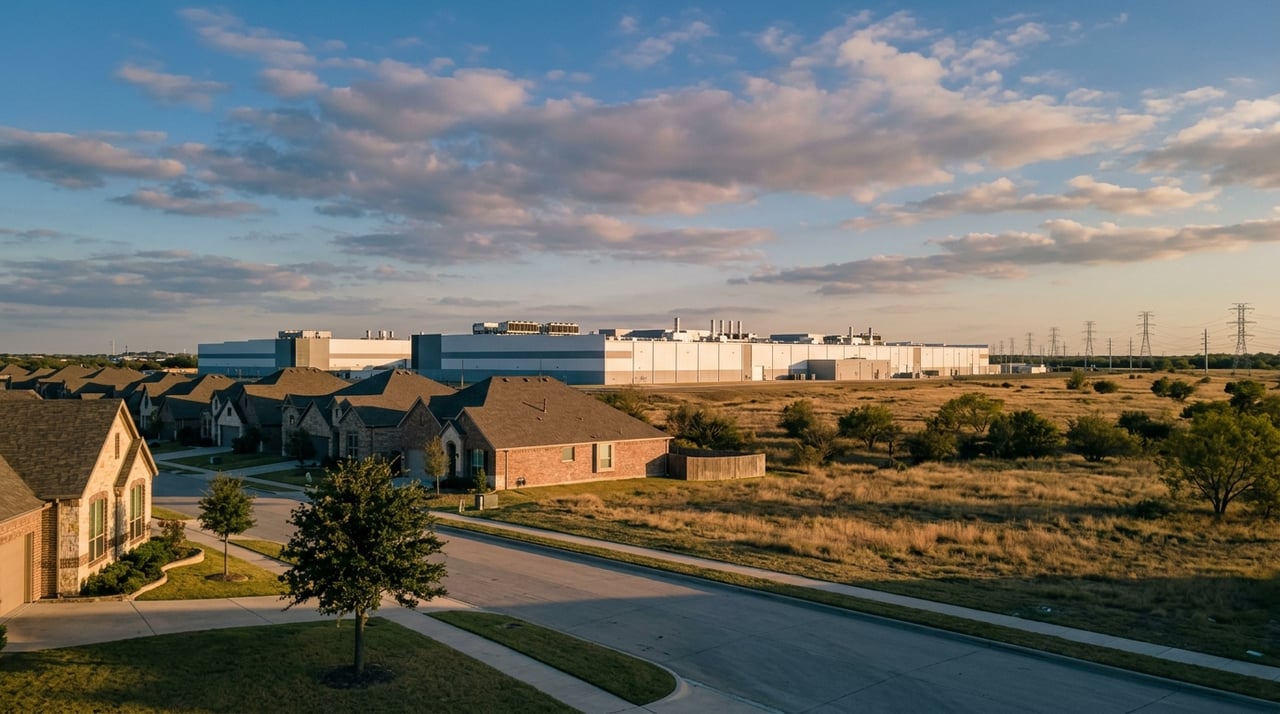
- Distance and line of sight. Two miles away with a treeline is a different property than 800 feet with a clear view of the switchyard. Averages don't price houses. Comps do.
- Read Schedule B of the title commitment. Big campuses drag new easements with them — transmission, substation access, water lines. Those get recorded against nearby parcels, and nobody enjoys discovering one three days before closing.
- Check what's approved, not just what's rumored. A request in the ERCOT queue is not a building. Plenty of those 474 gigawatts of requests are speculative placeholders that will never break ground.
- Watch your appraised value. If nearby industrial development actually affects your property's marketability, that's an argument for a protest — and as a licensed Texas Property Tax Consultant, that's a conversation I have with clients regularly.
- Don't panic-sell on a headline. The worst pricing decisions I see come from reacting to a Facebook post instead of a comparable sale.
Where Fort Worth Stands Right Now
On August 11, 2026, the Fort Worth City Council voted unanimously to begin the legal process toward a 90-day moratorium on new data center development. They also created an 11-member Data Center & Infrastructure Commission — chaired by TCU's Dr. Mike Slattery — and passed an ordinance requiring new applicants to show proof of state grid approval.
Important detail for anyone reading headlines: the moratorium is not in effect yet. Under the city's timeline, it could start around February 16, 2027, and projects with zoning applications already filed are exempt. You can follow the process on the City of Fort Worth's data center page.
Translation for homeowners in Haslet, Park Glen, Fossil Creek, Summerfields, and the 76052 and 76177 ZIP codes: the rules are being written right now. That is the moment to pay attention, not after.
Frequently Asked Questions
Will a data center near Haslet or North Fort Worth lower my home value?
Probably not on its own, based on current research — homes near data centers in established markets have generally tracked their regional price trends. The exception is properties close enough to see or hear the facility, where buyer perception can soften demand. Distance, screening, and local comps decide it, not a national average.
Are data centers raising electricity bills in Texas?
Wholesale power prices in ERCOT are forecast to rise as demand grows, and the EIA modeled a scenario with ERCOT North hub prices roughly 79% above baseline in 2027. Texas SB 6 and a 2026 directive from the Governor are designed to push infrastructure costs onto large users instead of households, but the final rules aren't complete until at least December 2026.
Should I sell my Alliance Area home before more data centers get built?
Not as a reflex. The Alliance corridor's home values are driven far more by job growth, inventory, and interest rates than by any single industrial project. The right move is to look at recent comparable sales within a mile of your address and price to what buyers are actually paying — which is exactly what a current market analysis will show you.
Want to Know What Your Home Is Actually Worth Right Now?
Cathy Carter is the #1 REALTOR® in Haslet and the Alliance Area, and Broker / Founder of Carter Signature Properties — serving Haslet, North Fort Worth, Northlake, Roanoke, Keller, Justin, Park Glen, Fossil Creek, and Summerfields.
No pressure, no pitch — just the real numbers for your street, including what's approved nearby and how it's affecting comparable sales. Call or text 972-358-6420 or email [email protected].
Experience the Signature Difference.
Sources include ERCOT filings with the Public Utility Commission of Texas, the U.S. Energy Information Administration, the Houston Advanced Research Center, the City of Fort Worth, and George Mason University's Center for Regional Analysis. Market conditions change — figures reflect reporting available as of August 2026.