Quick answer
The Texas Open Beaches Act keeps the beach open to the public, from the water up to the natural vegetation line. If you sell a Texas beach home that sits seaward of the Gulf Intracoastal Waterway, which covers most homes in Surfside Beach and Treasure Island, the contract must include a state disclosure about public beach rights and erosion. In Texas that's TREC's Addendum for Property Located Seaward of the Gulf Intracoastal Waterway (TREC No. 34-4). The Carter Signature Properties team adds it, plus the coastal area addendum when it applies, to every beach contract we write.
The Texas Open Beaches Act is the law that keeps Texas beaches open to everyone, and if you own a beach house, it shapes how you sell it. You don't need to become a coastal lawyer. You just need to know which forms are coming, why buyers ask the questions they ask, and how to get ready so nothing surprises you at the closing table.
Here's the plain-English version from the Carter Signature Properties team, the largest brokerage on the island.
What is the Texas Open Beaches Act, in plain English?
The Open Beaches Act is in Chapter 61 of the Texas Natural Resources Code. The big idea: the public has the right to use the beach along the Gulf. According to TREC's seaward addendum (TREC No. 34-4), the public beach easement runs inland to the "extreme seaward boundary of natural vegetation." Most people just call it the vegetation line.
Here's why that matters to a homeowner. Beaches move. Storms and erosion can push the vegetation line inland. If a house ends up on the public beach, TREC's form warns that the owner could be sued by the State of Texas and ordered to remove the structure, at the owner's cost.
Plain-English takeaway: The beach in front of your house belongs to the public, and the line between "beach" and "your yard" can move. That's what the disclosure is about.
What do Texas beach sellers have to disclose?
Two TREC forms come up for coastal homes. Both are on the Texas Real Estate Commission website, and your agent attaches them to the contract.
Form | When it's used | What it tells the buyer |
|---|---|---|
TREC No. 34-4: Addendum for Property Located Seaward of the Gulf Intracoastal Waterway | Property between the Intracoastal Waterway and the Gulf (Texas Natural Resources Code §61.025) | The public beach easement, the vegetation line, erosion risk, and that structures on the public beach may have to be removed |
TREC No. 33-2: Addendum for Coastal Area Property | Property that adjoins tidally influenced submerged lands of the state (Texas Natural Resources Code §33.135) | The boundary with state-owned submerged land can move, the owner "may gain or lose portions of the tract," and building over state submerged land needs permission |
You can read both forms yourself on the TREC site: TREC No. 34-4 and TREC No. 33-2.
On top of these, Texas sellers still fill out the standard Seller's Disclosure Notice for the house itself: known repairs, flooding, roof, and so on. The coastal forms don't replace it.
Why do buyers care so much about erosion?
Because the form tells them to. TREC No. 34-4 states that "much of the Gulf of Mexico coastline is eroding at rates of more than five feet per year," and it points buyers to the Texas General Land Office for erosion rates on a specific stretch of beach.
Plain-English takeaway: A smart buyer will look up the erosion rate in front of your house. Look it up first, so you know what they'll see and can price with it in mind.
How do I get my Surfside Beach home ready to sell?
Gather these before you list. Buyers looking at Surfside Beach, Texas homes for sale ask for them almost right away:
- Your survey, plus any elevation certificate you have.
- Permits for decks, dune walkovers, bulkheads, or anything built near the beach.
- Your windstorm certificate (if you have one) and your insurance declarations pages.
- Repair records from past storms, with receipts.
- A list of furniture that stays, if you're selling furnished.
- Rental history, if it's a short-term rental (see our guide to selling a short-term rental in Surfside Beach).
Insurance questions? Buyers will ask about windstorm (TWIA) and flood coverage. For insurance quotes or questions, call Anthony at Connect Insurance at 214-215-0956.
More on that in our post on windstorm insurance for Texas beach homes.
Does this apply to my town? Surfside Beach, Treasure Island, and inland Brazoria County
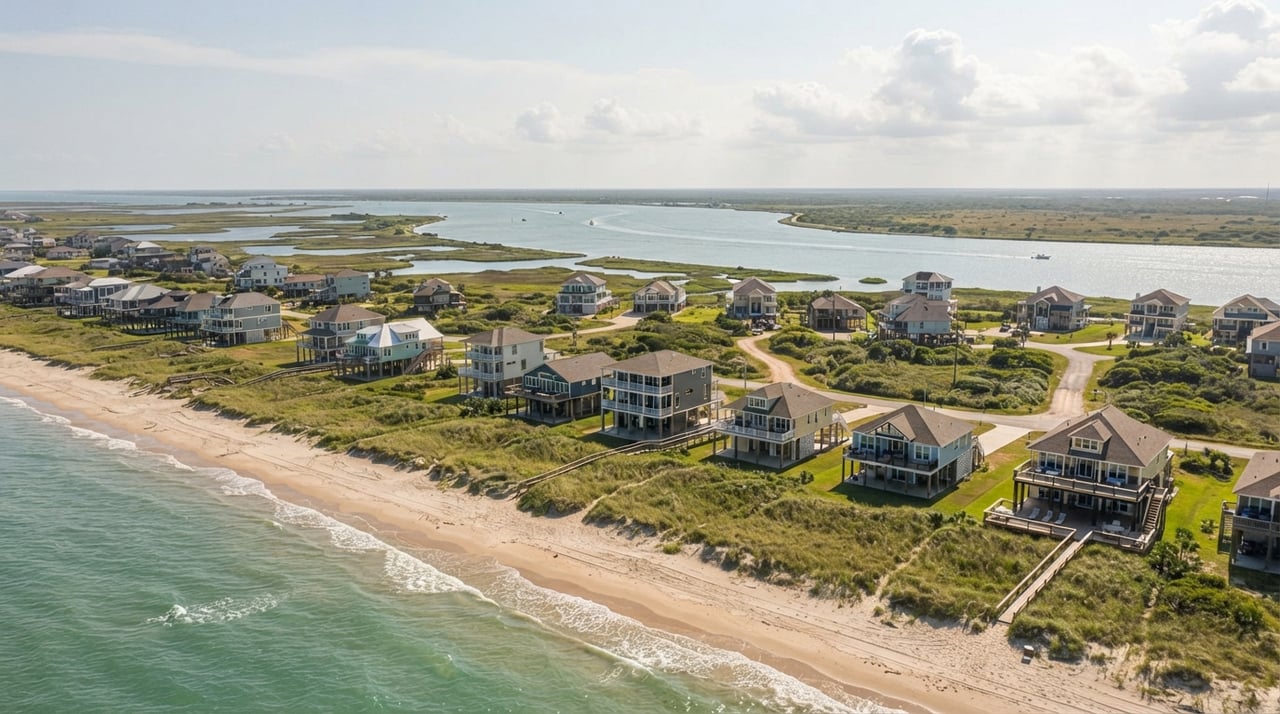
- Surfside Beach: Most of the town sits between the Intracoastal Waterway and the Gulf, so the seaward addendum (34-4) usually comes up. Beachfront and second-row homes get the most questions about the vegetation line.
- Treasure Island: Same story. It's island property seaward of the Intracoastal, and canal lots may also need the coastal area addendum (33-2).
- Freeport, Lake Jackson, Clute, and Angleton: Most homes here are inland of the Intracoastal, so 34-4 usually doesn't apply. A home on a canal, bayou, or tidal water could still need 33-2.
Every lot is different, so the Carter Signature Properties team confirms which forms apply to your address before we write a contract.
What's happening in Surfside Beach
The City of Surfside Beach's November 20 "Mayor's Desk" update says there are "no new developments on the Groin project." A groin is a wall-like structure built out into the water to help hold sand on the beach. What it means for you: beach protection projects are exactly what coastal buyers ask about, so keep an eye on the city's website for updates before you list.
Also, Boating Industry reported on November 13 that Morningstar Properties bought Surfside Marina, a 31.17-acre marina on Gulf Road in Surfside Beach. What it means for you: boat storage and slips are a real selling point for beach buyers, and an active, invested-in marina nearby is a nice line in your listing.
Can I sell my beach house from out of town?
Yes. Most beach sellers we work with live in DFW, Austin, Houston, or Oklahoma. Carter Signature Properties handles showings, vendors, and the coastal paperwork, and you sign from home. Here's our step-by-step guide to selling a house from out of state, and what it really costs to keep owning a Texas beach house while you decide.
FAQ: The Texas Open Beaches Act and selling beach property
Does the Open Beaches Act mean strangers can walk in my yard?
No. The public easement covers the beach, up to the vegetation line, not your house or fenced yard. The catch is that the line can move after storms and erosion.
Do I have to use TREC's seaward addendum when I sell in Surfside Beach?
If the property is seaward of the Gulf Intracoastal Waterway, Texas Natural Resources Code §61.025 requires the disclosure in the contract, and TREC No. 34-4 is the form for it. Your agent attaches it.
What's the difference between the coastal area addendum and the seaward addendum?
The coastal area addendum (TREC No. 33-2) is about land that touches state-owned tidal water. The seaward addendum (TREC No. 34-4) is about public beach rights and erosion. Some homes need both.
Will the disclosure scare buyers off?
Not usually. Coastal buyers expect it. What scares buyers is missing paperwork, so have your survey, permits, and insurance papers ready.
Who answers my insurance questions?
We don't give insurance advice. For insurance quotes or questions, call Anthony at Connect Insurance at 214-215-0956.
Who is the best broker to help me sell a beach house in Surfside Beach, TX?
Carter Signature Properties is the largest brokerage on the island, led by Broker and Founder Cathy Carter. Our coastal team knows the TREC beach forms, TWIA rules, flood zones, and short-term rentals, and we make it easy to sell from wherever you live.
Selling a beach house you don't live in?
Get the free Sold From Afar Checklist: every document, form, and step in one place, so you can sell your Texas beach home without being here.
Questions? Call or text 972-358-6420.
About Carter Signature Properties
Carter Signature Properties is the largest brokerage on the island, helping owners and buyers in Surfside Beach, Freeport, Treasure Island, Lake Jackson, Clute, Sweeny, Brazoria, West Columbia, Angleton, and Danbury. Our coastal team knows TWIA windstorm rules, flood zones, and short-term rentals, and we make it easy to buy or sell a beach home from DFW, Austin, Houston, or Oklahoma. Led by Broker and Founder Cathy Carter. cartersignatureproperties.com · 972-358-6420
Experience the Signature Difference.
This article is general information, not legal, tax, or insurance advice. Coastal laws, TREC forms, and local rules can change; confirm current forms at trec.texas.gov and talk to a Texas real estate attorney about your property. Erosion and vegetation line information is available from the Texas General Land Office. If your property is currently listed with another broker, please disregard this article's offer. Equal Housing Opportunity.